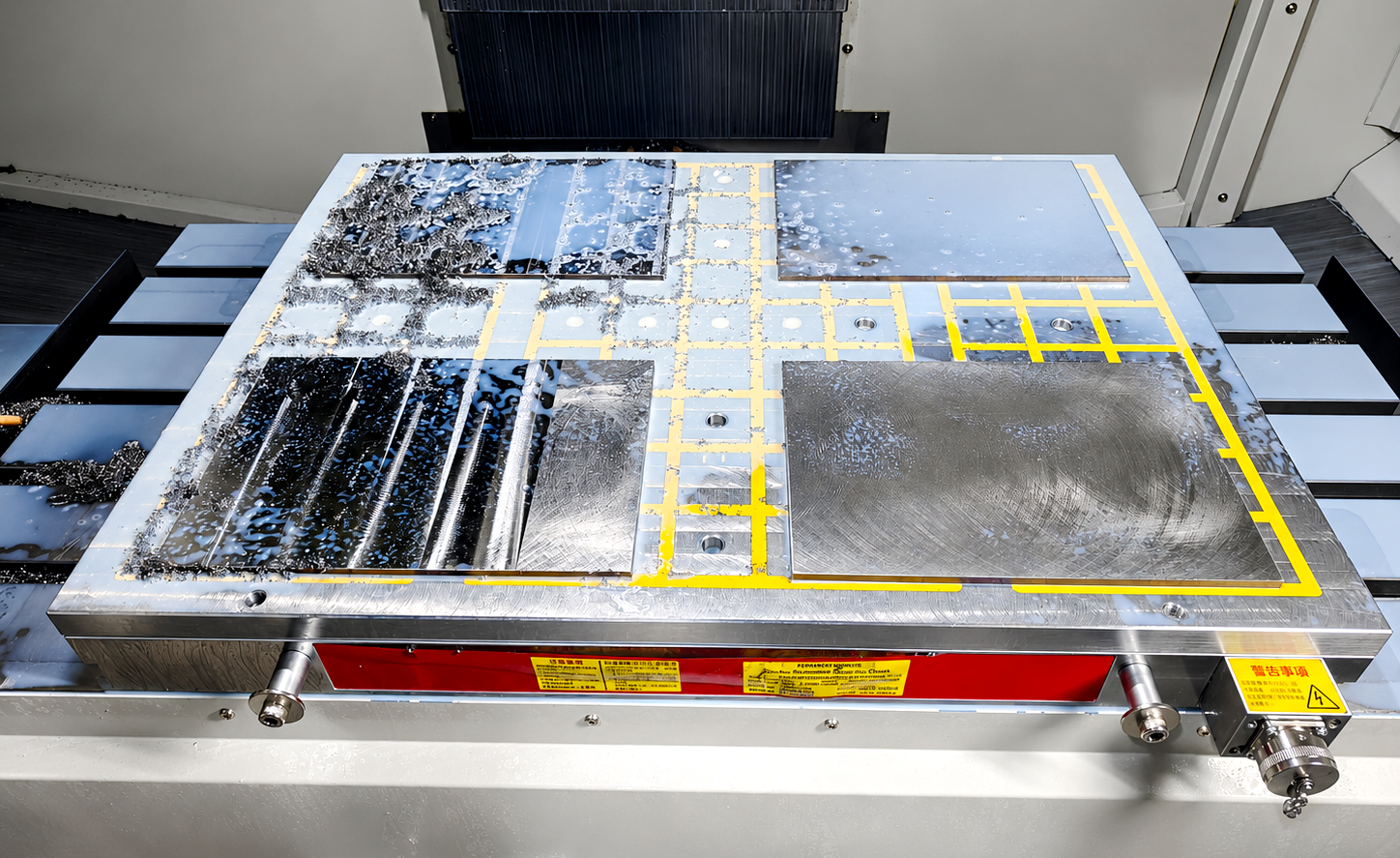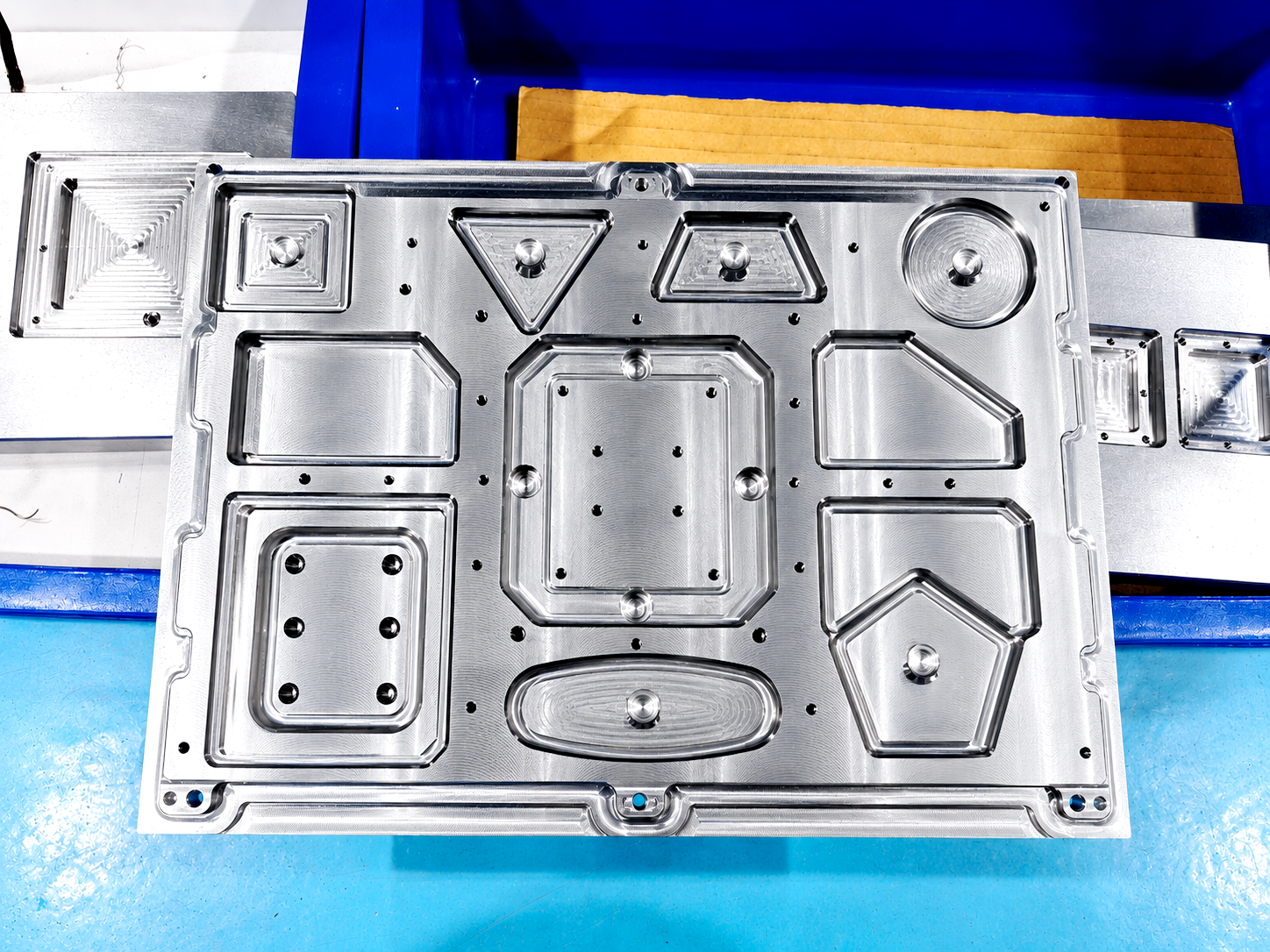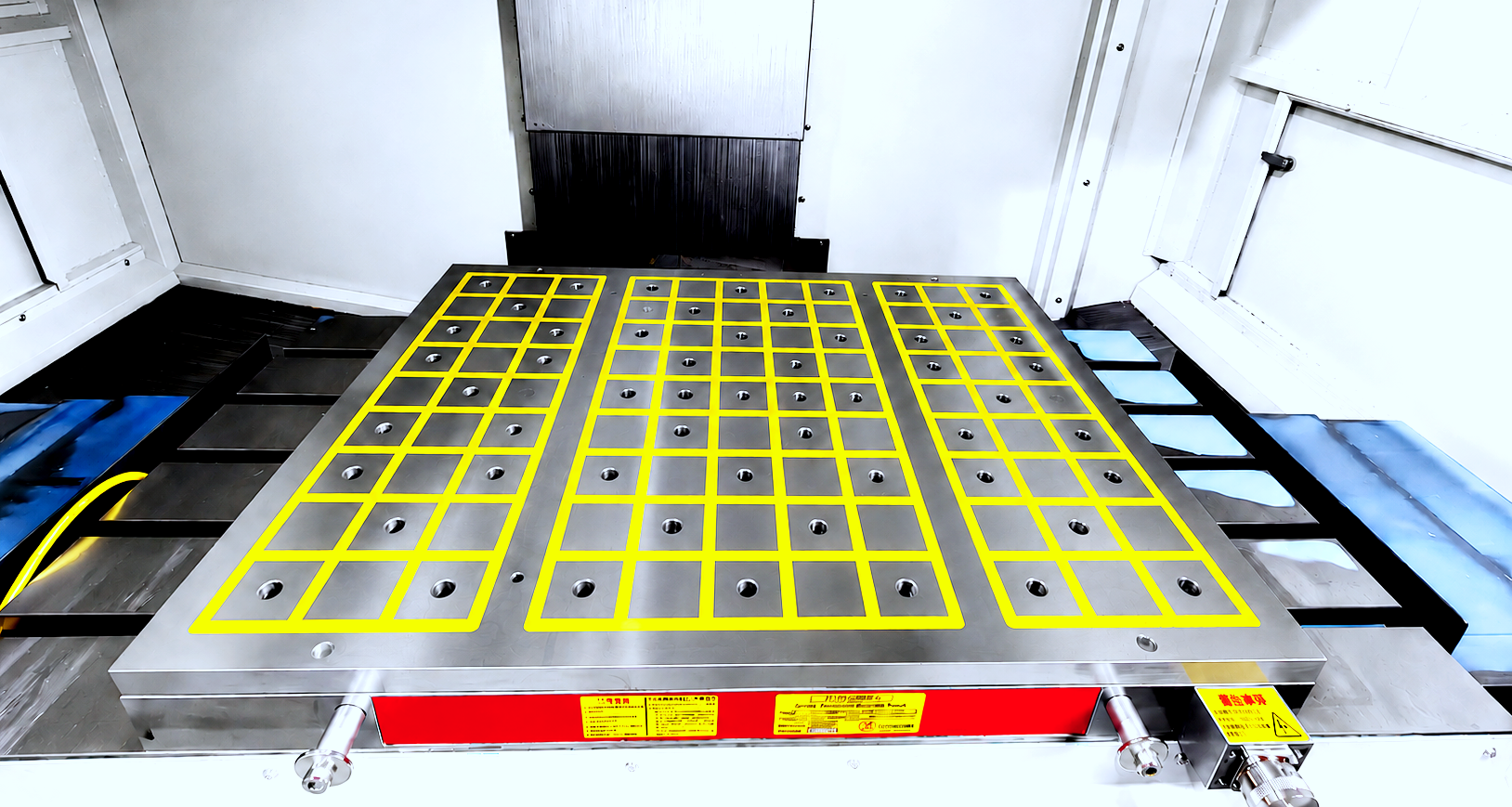
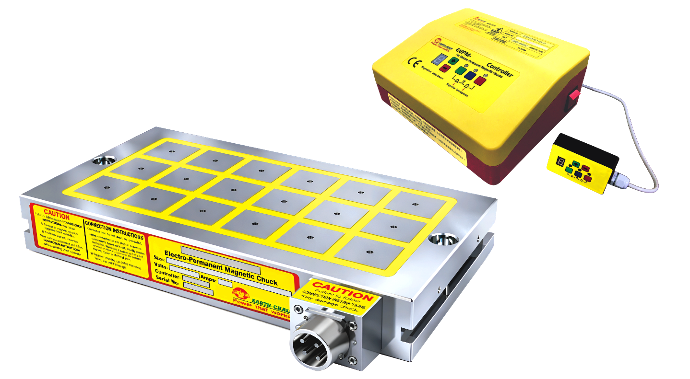
Driven by the rapid growth of AI infrastructure, demand for semiconductor equipment components has increased significantly. To meet urgent production requirements, Earth-chain Electro Permanent Magnetic Chucks have been developed for machining thin stainless steel sheets used in semiconductor manufacturing equipment.
For applications such as hole drilling, slot machining, and flow channel groove processing on ultra-thin stainless steel sheets, magnetic chuck systems can significantly improve workpiece stability, machining efficiency, and production yield.
Challenges of Traditional Clamping Methods
1. Ultra-Thin Stainless Steel Sheets Are Prone to Deformation
Thin stainless steel sheets are widely used in semiconductor equipment. When conventional vises, clamps, or screw-fastening methods are used, concentrated clamping forces often cause warping, bending, or localized deformation. During operations such as hole machining, channel groove cutting, and thin-wall milling, insufficient rigidity combined with unstable clamping can lead to vibration, tool deflection, burr formation, and dimensional inaccuracies, ultimately affecting assembly precision.
2. Screw Fastening Requires Significant Setup Time
Traditional machining requires operators to tighten screws, adjust clamps, and verify positioning before processing. Each workpiece requires repeated fastening and removal procedures. When handling urgent AI-related orders or high-volume production, screw fastening becomes a bottleneck, increasing setup time and labor requirements.
3. Limited Workpiece Capacity Reduces Productivity
Without a magnetic chuck, workpieces are typically secured using only a few clamping points. To avoid interference with tool paths, the number of workpieces that can be mounted simultaneously is limited. As a result, operators must frequently load and unload parts and repeatedly perform alignment procedures, reducing effective machine utilization and overall production efficiency.
4. Workpiece Movement Can Affect Machining Accuracy
If thin stainless steel sheets are not securely fixed, cutting forces, machine vibration, or coolant flow may cause slight movement during machining. Even minor displacement can result in hole position errors, inconsistent slot widths, and dimensional deviations. Semiconductor equipment components require high precision and consistency, making such defects costly due to rework, scrap, and delivery delays.
5. Increased Labor and Management Costs
Traditional clamping methods require more operator involvement for fastening, alignment, removal, and inspection. As production volume increases, labor demand grows accordingly. In environments facing labor shortages or tight delivery schedules, conventional fixturing methods limit the ability to scale production efficiently.
Benefits of Using Earth-Chain Magnetic Chuck Systems
1. Reduced Deformation of Thin Stainless Steel Sheets
Magnetic chucks provide uniform holding force across a large surface area, minimizing deformation caused by concentrated clamping pressure. For hole drilling, slot machining, and flow channel groove processing on ultra-thin stainless steel sheets, magnetic holding improves flatness and machining stability. Compared with conventional point-contact clamping methods, magnetic clamping is more suitable for thin-sheet applications and helps reduce warping, vibration, and dimensional variation.
2. Eliminate Screw Fastening and Improve Efficiency
With magnetic chuck systems, operators simply position the workpiece and activate the magnetic holding force. There is no need for repetitive screw tightening, loosening, or clamp adjustments. This significantly reduces setup time, minimizes manual operations, and allows personnel to focus on quality control and production management.
3. Multiple Workpieces Can Be Processed Simultaneously
A single magnetic chuck can accommodate multiple stainless steel sheets based on part size and machining requirements. Multi-part processing reduces loading and unloading frequency while increasing machine utilization. For high-volume production and urgent orders, this capability shortens overall production cycles and accelerates delivery.
4. Faster Loading and Unloading Operations
The workflow with magnetic chucks is straightforward: load, position, magnetize, machine, demagnetize, and unload. Compared with traditional fixtures that require repeated fastening and removal, magnetic chucks significantly reduce non-cutting time. The accumulated time savings become substantial when processing large production batches.
5. Improved Machining Quality and Yield
Stable magnetic holding minimizes workpiece vibration and movement, allowing cutting tools to perform more consistently. For semiconductor components requiring precise hole locations, slot dimensions, flatness, and profile accuracy, magnetic chucks help improve machining consistency. Stable machining conditions also reduce burr formation, rework rates, and material scrap.
6. Ideal for High-Efficiency Semiconductor Component Manufacturing
Semiconductor equipment commonly requires precision stainless steel components such as: Flow channel plates, Fluid routing plates, Mask plates, Shielding plates, Mounting plates, Precision structural components, Earth-Chain Magnetic Chucks help manufacturers respond quickly to AI-driven production demand by enabling rapid setup, fast changeovers, multi-part machining, and stable mass production, thereby enhancing manufacturing flexibility and competitiveness.
Conclusion
Without magnetic chucks, ultra-thin stainless steel sheets are susceptible to deformation caused by conventional clamping methods. Machining processes often suffer from vibration, workpiece movement, dimensional instability, and excessive loading/unloading time. During urgent semiconductor equipment production, screw fastening and single-part machining can significantly limit throughput.
By utilizing Earth-Chain Magnetic Chuck Systems, manufacturers can achieve uniform surface holding, ensuring stability during hole drilling and channel groove machining while minimizing deformation. The elimination of screw fastening reduces labor requirements, and the ability to process multiple workpieces on a single chuck dramatically decreases setup and handling time. As a result, customers can improve productivity, machining quality, production yield, and delivery performance, gaining a stronger competitive advantage in the semiconductor manufacturing industry.